Wednesday, May 17, 2023

Red-haired first and founders, 6th part (251 - 300)

While working at our partner blog Famous Redheads in History I couldn’t help but notice the great number of “first” and “founders” among our famous redheads. Here’s the list from 251 to 300.

First part. Second part. Third part. Fourth part. Fifth part.


251) Barbara Ann Scott: she is the only Canadian to have won the Olympic ladies' singles gold medal, the first North American to have won three major titles in one year and the only Canadian to have won the European Championship (1947–48). 


252) Sidney Franklin: first American to become a successful matador, the most senior level of bullfighter.


253) Annabelle Rankin: first woman from Queensland elected to parliament, first woman federal departmental minister, and first Australian woman to be appointed head of a foreign mission. She remains the longest-serving whip in the party's history, in either chamber of parliament. In 1966, she was made Minister for Housing in the Holt government, becoming the first woman to hold a ministerial portfolio. As High Commissioner to New Zealand from 1971 to 1974, she was the first woman to head an Australian mission overseas. 


254) Ursula Hirschmann: co-founder of the European Federalist Movement (Milan, 27 and 28 August 1943). Founder of the Association Femmes pour l'Europe (Brussels, 1975). 


255) Miriam Rothschild: first person to work out the flea's jumping mechanism. She was the first woman trustee of the Natural History Museum (1967–1975), the first woman president of Royal Entomological Society (1993–1994), the first woman to serve on the Committee for Conservation of the National Trust, and the first woman member of the eight-member Entomological Club. 


 256) Audrey Meadows: first woman to serve as director of the First National Bank of Denver. 


257)  James Archibald Campbell: founder of the Campbell University (originally Buies Creek Academy) in Buies Creek, North Carolina in 1887. 


258) Richard Q. Hoare: founder, in 1983, of the Bulldog Trust, to provide support and advice for charities facing immediate financial difficulties. The trust is based at and owns Two Temple Place in the City of London.


259) Mary Thurman: in 1920 she adopted the Dutch bob hairstyle, thus becoming the first celebrity with the style that became a craze among young fashionable women known as "flappers" during the 1920s and early 1930s.


260) William Lucking: in 1986, with fellow actor Dana Elcar, he co-founded the Santa Paula Theater Center. 


261) Bernard of Clairvaux: co-founder of the Knights Templar, and major leader in the reformation of the Benedictine Order through the nascent Cistercian Order. 


262) Peter Beneson: co-founder, along with Seàn MacBride, of Amnesty International. 


263) Clive Sinclair: founder of Sinclair Radionics Ltd in 1961. He produced the world's first slimline electronic pocket calculator (the Sinclair Executive) in 1972 and the UK's first mass-market home computer for less than £100. He was also an early pioneer of electric vehicles with his Sinclair C5. 


264) Ebenezer Denny: first mayor of Pittsburgh. 


265) Ninian Beall: founder of Georgetown.


266) Isabella II of Spain: she is the only queen regnant in the history of unified Spain. 


267) Alan Rufus: according the 2007 book The Richest of the Rich, by Philip Beresford and William D. Rubinstein, Alan Rufus is the wealthiest English individual of all times. 


268) Liu Yuan: founding emperor of the Xiongnu-led Han-Zhao dynasty of China during the Sixteen Kingdoms period


269) Saint Sava: founder of Serbian law, founder of the monastery of Hilandar, he is also regarded as the founder of Serbian medieval literature. 


270) Dorothy Hart: first female entertainer of the American Association for the United Nations in New York. 


271) Jannik Sinner: first Italian tennis player to win the Wimbledon tournament. 


272) Boris Becker: he was the youngest ever male Grand Slam singles champion at 17 years, and the only male tennis player two win two Grand Slams before turning 19. He is the youngest Wimbledon singles champion (17-year-old). 


273) Jean Carl Harrington: he has been called the "father of historical archaeology in America". 


274) Joseph Patrick McDonnell: he was one of the founders of the International Labor Union.


275)  Eugenio Monti: first non-German to win a gold in both the two-man and four-man events in the 1968 Winter Olympics in Grenoble.


276) Jadwiga of Poland:  first female monarch of the Kingdom of Poland, as well as its last hereditary ruler. 


277) Tennessee Claflin: first woman, along with her sister Victoria Woodhull, to open a Wall Street brokerage firm, which occurred in 1870.


278) William Peden: in 1932, he set the record (that still stands) of 10 victories in six-day cycling racing.


279) Mary Elizabeth Braddon: in 1866, she founded the magazine Belgravia.

Monday, May 8, 2023

Red hair says carrots

If you’re familiar with this blog and its website, you are probably aware of the ambiguous attitude towards red hair: over the centuries and millennia, it was loved and hated at the same time. Painters definitely favoured red hair over any other hair colour, while common people linked it to disloyalty and treachery (see, for instance, all the proverbs we have gathered). 

Sometimes we even have what it seems a nearly schizophrenic attitude. For esample, as you can read here, Peter the Great of Russia issued a decree forbidding redheads to hold any public office, testifying in courts and working on ships, because, he said, "God marks the rascal!" However, according to our research, Peter the Great was a redhead himself. 

Peter the Great of Russia


My first thought, when I read of this decree, was that Peter the Great made a distinction between very light red hair (orange hair) and copper hair, so, when he referred to redheads, he was in fact referring only to people with orange-coloured hair. I didn’t have any evidence of that, though.

Few weeks ago I was re-reading a novel by Agatha Christie, Appointment with Death. One of the characters, a young woman, has got beautiful red-golden hair and another character comments on it and says: “The sun was in my eyes, so I couldn’t quite see. But I don’t think the hair was red—just bronze. I’m so fond of that coppery bronze hair! Red hair always says carrots to me!”

So, it seems that for certain people the adjective red only applied to carrot/orange hair, while the darker shade was, for them, bronze or copper, not red. This carrot shade wasn’t considered very beautiful, unlike the copper one. It also came to my mind the famous quote from Mark Twain:


Now the question is: why? Was it just a matter of aesthetics? Or maybe people found it ridiculous that somebody’s hair colour was so similar to a vegetable? It Peter the Great even made a decree banning redheads from certain activities, probably it wasn’t just a matter of aesthetics or of vegetables. In some countries there are also expressions like carrot top, poil de carotte (French) and pel di carota (Italian) which can be used in a derogatory sense as well.

In the light of Mark Twain’s quote, it seems that, for whatever reason, red (carrot) hair was linked to lower classes, while the coppery/bronze shade was linked to aristocrats.  

We need to go on with our research and find out if there is any truth to this, and the reason for it.

Saturday, January 28, 2023

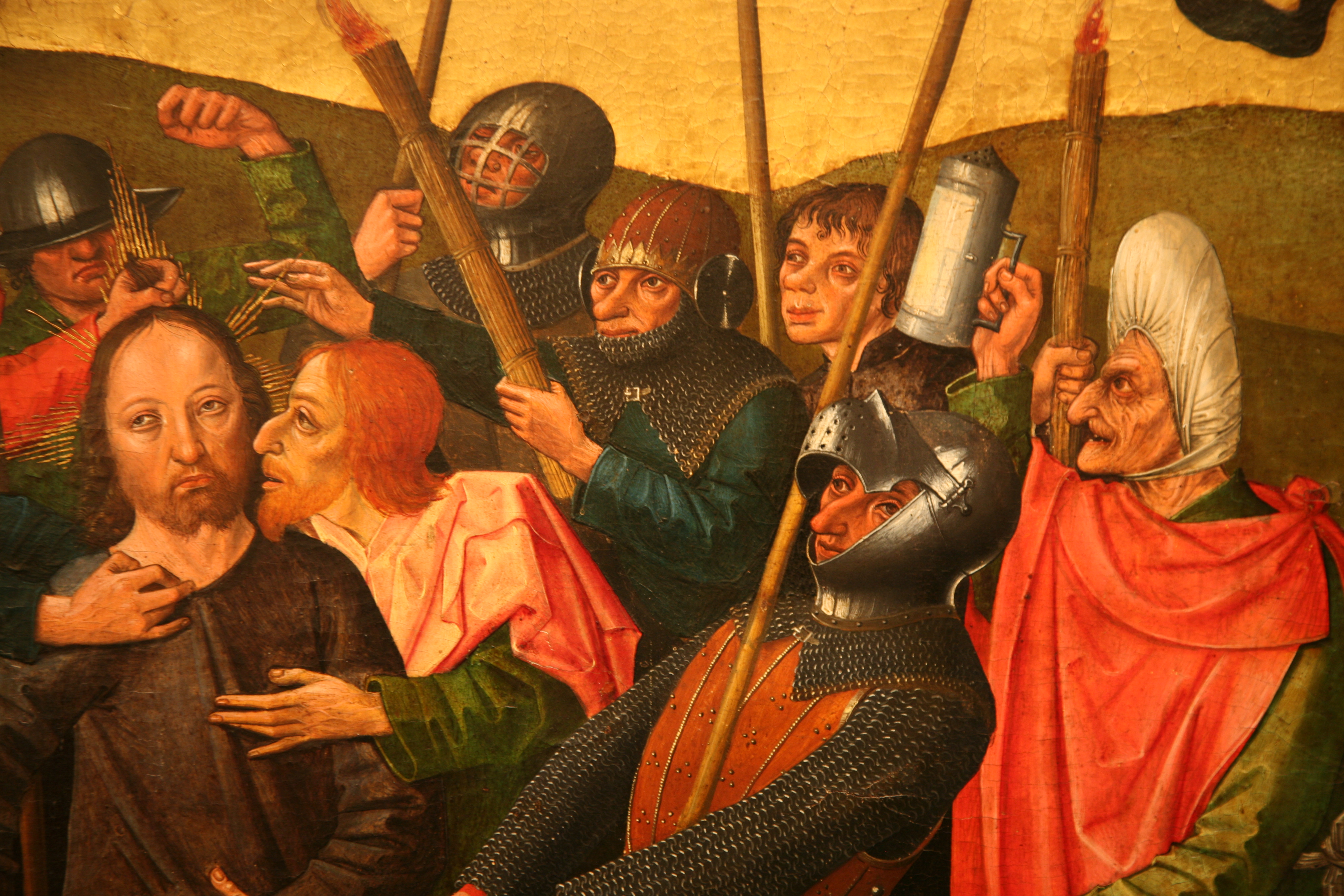
Judas's Red Hair, by Paull Franklin Baum

The other day I came across an article entitled Judas's Red Hair, from The Journal of English and Germanic Philology, Jul., 1922, Vol. 21, No. 3 (Jul., 1922), pp. 520-529.

The author, Paull Franklin Baum, tries to understand where the popular belief that Judas had red hair comes from. As you know, in fact, in the Bible there is no reference to the colour of Judas' hair. In reality, Baum does not clarify the matter much and concludes that the Judas/red hair association is probably due both to the ambivalence of the colour red and to this hair colour being rather rare and the result of a "degeneration" (the concept of genetic mutation was probably not yet known).

Jan van Dornicke, The Arrest of Christ


The interesting thing about the article are the various historical references to the expression "Judas' colour" and several proverbs about red hair (unfortunately not translated by the author).
Here is a passage on the expression Judas colour (pages 521/522):

The phrase Judas color and the adjective Judas-colored seem to have been current chiefly among the Elizabethan dramatists and their imitators. The earliest example I have met is in Kyd's Spanish Tragedy: "And let their bear des be of ludas his owne collour." In As You Like It, Act III, sc. iv, Rosalind says: "His hair is of the very dissembling colour." And Celia replies: "Something browner than Judas's." Other instances are: "Sure that was Judas with the red beard," in Middleton's Chaste Maid in Cheapside, III, ii; "That's he in the ludas beard," in Robert Daborne's A Christian Turn'd Turke, I, iv; "I ever thought by his beard he would prove a Judas," in Marston's The Insatiate Countess, II, ii. Dryden writes in Amboyna: "There's treason in that Judas-colour'd beard"; and his lines on Tonson are well known:
"With leering looks, bull-fac'd and freckled fair,
With frowsy pores poisoning the ambient air,
With two left legs, and Judas-colour'd hair."
Sir Roger L'Estrange inserted an allusion to Judas's hair in his translation of Quevedo's Sueños:
"I next went down a pair of Stairs into a huge Cellar, where I saw Men burn ing in unquenchable Fire, and one of them Roaring, Cry'd out, I never over sold; I never sold, but at Conscionable Rates; Why am I punished thus? I durst have sworn it had been Judas; but going nearer to him, to see if he had a Red Head, I found him to be a Merchant of my Acquaintance."
In the poets of the last century there are occasional examples of this notion; as in Tennyson's Queen Mary, written in the Elizabethan manner:
"First Citizen. I thought this Philip had been one of those black devils of Spain, but he hath a yellow beard.
Second Citizen. Not red like Iscariot's.
First Citizen. Like a carrots, as thou say'st. (Ill, i)."
And R. S. Hawker, the Cornish poet, has: "The sickly hue of vile Iscariot's hair."
A variation of the usual tradition appears in the North of England, that Judas had black hair and a red beard. This matches the German proverb: "Schwarzer Kopf, rother Bart, bose Art," and the French “Barbe rouge et noirs cheveux Guettes t'en, si tu peux.


The Warendorfer Altar, by Geza Jaszai   
 

My translation of the proverbs above:

Schwarzer Kopf, rother Bart, bose Art (Black head, red beard, evil manner)
- Barbe rouge et noirs cheveux, Guettes t'en, si tu peux (Red beard and black hair, Watch out, if you can). 

Here are two more German proverbs in the text:

- Roter Bart, untreue Art (Red beard, unfaithful kind).
- Hüet dich vor aim roten Walhen, weissen Franzosen, schwarzen Teutschen (Beware of red Gauls, white Frenchmen, black Germans)

There are also quotes in Latin:

- Rufus quidam ventriosus, crassis suris, of Plautus (Pseud. IV, 7, 110) (Redhead, a certain bellied, fat pig).

"And it is significant that the earliest documentary evidence of the proverb as proverb appears in a fragment of the Ruotlieb, a Latin poem of the early eleventh century by an anonymous Tegernsee monk, who may well - there is evidence of other kinds pointing to southern influence there - have had this notion from Italy: "Non tibi sit rufus unquam specialis amicus" is one of the twelve saws with which the young man is rewarded." page 525 (Don't ever have a redhead as your special friend).
The Betrayal of Christ, by Hans Holbein 

The interesting thing is that, if on the one hand we have the popular tradition that paints Judas with red hair, on the other we have (as you certainly know if you follow this blog) many painters who paint both Jesus and the Madonna with this hair colour . Indeed, certainly the Jesuses and Madonnas with red hair are much more numerous than the Judas with red hair. So it is as if even for red hair there was that dichotomy that the author describes at the beginning of the article for the colour red. Perhaps those painters knew something that, at a popular level, was not known? Or perhaps they made a distinction between carrot red (with negative connotations) and copper red/auburn, with more positive connotations?


The Betrayal of Christ, by Caspar Isenmann