Wednesday, August 10, 2022

Red-haired ancient tribes: the Yenisei Kyrgyz

The Kyrgyz people (also spelled Kyrghyz, Kirgiz, and Kirghiz) are a Turkic ethnic group native to Central Asia, primarily Kyrgyzstan.


The early Kyrgyz people, known as Yenisei Kyrgyz, have their origins in the western parts of modern-day Mongolia and first appear in written records in the Chinese annals of the Sima Qian's Records of the Grand Historian (compiled 109 BC to 91 BC), as Gekun or Jiankun. The Middle Age Chinese composition Tanghuiyao of the 8–10th century transcribed the name "Kyrgyz" as Jiegu (Kirgut).

According to recent historical findings, Kyrgyz history dates back to 201 BC. The Yenisei Kyrgyz lived in the upper Yenisey River valley, central Siberia. In Late Antiquity the Yenisei Kyrgyz were a part of the Tiele people. Later, in the Early Middle Ages, the Yenisei Kyrgyz were a part of the confederations of the Göktürk and Uyghur Khaganates.

In 840 a revolt led by the Yenisei Kyrgyz brought down the Uyghur Khaganate, and brought the Yenisei Kyrgyz to a dominating position in the former Second Turkic Khaganate. With the rise to power, the center of the Kyrgyz Khaganate moved to Jeti-su, and brought about a spread south of the Kyrgyz people, to reach Tian Shan mountains and Xinjiang, bringing them into contact with the existing peoples of western China, especially Tibet. 

(For more information about the history of the Kyrgyz people, you can continue reading here, here and here),

Today, most Kyrgyz people have dark hair and dark eyes.


However, it seems in the past they were a bit different. According to the Tang Huiyao, (961 AD), which very likely comes from the Xu Huiyao that Yang Shaofu and others completed in 852, citing Protector General of Anxi Ge Jiayun, the Kirghiz were described as having primarily Caucasian features, with some having East Asian features.

During the reign period of Kaiyuan of [emperor] Xuanzong, Ge Jiayun, composed A Record of the Western Regions, in which he said "the people of the Jiankun state all have red hair and green eyes. The ones with dark eyes were descendants of [the Chinese general] Li Ling [who was captured by the Xiongnu]... of Tiele tribe and called themselves Hegu. The change to Xiajiasi is probably because barbarian sounds are sometimes quick and sometimes slow so that the transcriptions of the words are not the same. When it is sometimes pronounced Xiajiasi, it is just that the word is quick. when I enquired from the translation clerk, he said that Xiajiasi had the meaning of 'yellow head and red face' and that this was what the Uighurs called them. Now the envoys say that they themselves have this name. I don't know which is right.

— Tang Huiyao, Chapter 100:1785; translated by Edwin G. Pulleyblank


9th-century author Duan Chengshi described the Kyrgyz tribe as "yellow-haired, green-eyed, red-mustached [and red-]bearded". New Book of Tang (finished in 1060) describes Alats, a medieval Turkic people, as resembling Kyrgyzes who were "all tall, red-haired, pale-faced, green-irised"; New Book of Tang also states that Kyrgyzes regarded black hair as "infelicitous" and insisted that black-eyed individuals were descendants of Han general Li Ling. source

Sometimes, these physical features still come up among Kyrgyz people.


According to a 2002 DNA analysis, haplogroup R1a1a is found in 64% of a sample of the Tajiks of Tajikistan and 63% of a sample of the Kyrgyz of Kyrgyzstan. Haplogroup R1a is common in Eurasia, extending from Scandinavia and Central Europe to Central Asia, Siberia and South Asia and the question of the origins of R1a1a is relevant to the ongoing debate concerning the urheimat of the Proto-Indo-European people, and may also be relevant to the origins of the Indus Valley civilization. 
The high frequency of R1a1a among the modern-day Kyrgyz may prove that they are descended from the Yenisei Kyrgyz and may also explain why medieval Chinese histories depicted the Kyrgyz as possessing West Eurasian features. 


Interestingly, the aforementioned Xinjiang is where the red-haired Tarim mummies have been found (we talked about them here and here) and maybe there is a connection with the Yenisei Kyrgyz. The earliest case of R* haplogroup was found among the Ancient North Eurasians of the Upper Paleolitic, and according to the 2021 DNA analysis by Zhang and colleagues, at least the most ancient among the Tarim mummies have high levels of Ancient North Eurasian ancestry (72%). For this reason, the Tarim mummies are considered the best representatives of the Ancient North Eurasians. So, it is possible that these ancient red-haired tribes we see in central Asia descended from the Ancient North Eurasians. 
 
The Yenisei River is famous for one more reason. On the left bank of it there is the archaeological site of Afontova Gora (Afont Mountain), which dates back to the  Late Upper Paloelithic and Mesolithic. Here, the remains of two individuals have been found, a male and a female. The female (a teenage girl), called Afontova Gora 3, is dated to around 16,090 BC and is the earliest individual known to carry the derived allele for blond hair. The Tarim mummies probably descended from a population represented by this individual. 
 
 
Here's an article about the possible connection between the Yenisei Kyrgyz and the Wusun. 
 
 
Further readings:
 

Thursday, June 2, 2022

The Red-Haired Giant of Kandahar

We have already covered, on this blog, the subject of red-haired giants.

Here's one more story on the same topic - the text is taken from the following article: https://allthatsinteresting.com/kandahar-giant

In August 2016, the YouTuber L. A. Marzulli posted a lengthy interview [which was then deleted] with a military contractor identified only as Mr. K. In the interview, Mr. K claimed to have been present during the brutal slaughter of a killer he called the Kandahar Giant.

The killing of the giant, he said, took place during the height of Operation Enduring Freedom in 2002 when the military was engaged in fierce battles with the Taliban in their de facto capital in Kandahar Province during the U.S. invasion of Afghanistan.

[..]

The Kandahar Giant, Mr. K said, was 13 feet tall with fiery red hair, six fingers, and two sets of teeth. It even killed one of the Special Forces soldiers with a spear before the rest of the unit brought it down with 30 seconds of sustained gunfire. And after they radioed it in, the Army took away its corpse and has hidden it ever since.

In 2002, a group of soldiers went missing while on patrol in a remote mountain region of Kandahar, in the south of Afghanistan. And when they failed to make radio contact for some time, the military sent in a special ops unit to investigate, though the branch of the armed forces they belonged to was never confirmed.

Then, high up in the mountains, the unit came across a cave with scattered Army equipment around but no sign of the missing soldiers. And that’s when they chanced upon the Kandahar Giant.

[..]

After the troops killed the giant, they loaded it onto a Chinook helicopter, which carried it to a transport plane, where no one ever saw it again. The soldiers were forced to sign non-disclosure agreements so the government could keep them all quiet.

[..]

In August 2016, Snopes reached out to the Department of Defense about the "Kandahar Giant incident." The Department of Defense told the outlet, in no uncertain terms, that they had "no record or information about a special forces member killed by a giant in Kandahar."

What’s more, there are no press releases on the Department of Defense’s website involving either a "special forces troop" disappearing in Afghanistan or of any incident involving soldiers felling a giant.

Of course, as with any good conspiracy, this lack of evidence isn’t sufficient proof that the myth of the Kandahar Giant doesn’t exist. In fact, Snopes’ debunking of the legend has had quite the opposite effect in certain cryptid spaces, which claim that the government is “trying to hide the truth” from the public.

Here are a couple of videos on the topic, including a new video by Marzulli.


For more information: WND, Indie88FM, TheXPlanet.

EDIT: apparently, the original interview by Marzulli has resurfaced. You can watch it here.

Saturday, April 23, 2022

Red Hair in the visions of Anne Catherine Emmerich

Anne Catherine Emmerich (also Anna Katharina Emmerick; 1774 – 1824) was a Roman Catholic Augustinian Canoness Regular of Windesheim, mystic, Marian visionary, ecstatic and stigmatist. 

She was born in Flamschen, a farming community at Coesfeld (Westphalia, Germany), and died at age 49 in Dülmen, where she had been a nun, and later become bedridden. Emmerich experienced visions on the life and passion of Jesus Christ, reputed to be revealed to her by the Blessed Virgin Mary under religious ecstasy.

During her bedridden years, a number of well-known figures were inspired to visit her. The poet Clemens Brentano interviewed her at length and wrote two books based on his notes of her visions. The authenticity of Brentano's writings has been questioned and critics have characterized the books as "conscious elaborations by a poet".

Emmerich was beatified on 3 October 2004, by Pope John Paul II.

Visions contained in The Life of The Blessed Virgin Mary were used during the discovery of the House of the Virgin Mary, the Blessed Virgin's supposed home before her Assumption, located on a hill near Ephesus, as described in the book Mary's House (neither Brentano nor Emmerich had ever been to Ephesus, and indeed the city had not yet been excavated).

In 1881 a French priest, the Abbé Julien Gouyet, used Emmerich's book to search for the house in Ephesus and found it based on the descriptions. The Holy See has taken no official position on the authenticity of the location yet, but in 1951 Pope Pius XII initially declared the house a Holy Place.

In 2003 actor Mel Gibson used Brentano's book The Dolorous Passion as a key source for his movie The Passion of the Christ.

(Anna Katharina Emmerick
by Gabriel von Max, 1885)

Many of her works are available online for free, like this one, where we found several references to red hair:

- Those first human beings [Adam, Eve and their children] had beautiful skin of a yellowish tinge, which shone like silk, and their hair was reddish-yellow like gold.

- When I saw him in Egypt, Job was a large, powerful man of agreeable appearance; he had a yellowish-brown complexion and reddish hair.

- (Moses) His complexion was brown, bright and ruddy, his hair inclined to red.

- The Blessed Virgin had auburn hair, dark eyebrows, fine and arched, a very high forehead... 

- (John the Baptist) His face was thin and haggard; his expression, grave and austere; his auburn hair in curls over his head, and his beard short.

 Jesus' hair is described as "golden".

Saturday, February 26, 2022

The Red Redmaynes, by Eden Phillpotts

Eden Phillpotts (1862 - 1960) was an English author, poet and dramatist. He was born in Mount Abu, British India, educated in Plymouth, Devon, and worked as an insurance officer for 10 years before studying for the stage and eventually becoming a writer.

He co-wrote two plays with his daughter Adelaide Phillpotts, The Farmer's Wife (1924) and Yellow Sands (1926); but is best known as the author of many novels, plays and poems about Dartmoor. His Dartmoor cycle of 18 novels and two volumes of short stories still has many avid readers despite the fact that many titles are out of print

;The Red Redmaynes is a detective story featuring two detectives, Mark Brendon, a young British police inspector who had risen rapidly with a string of successful cases, and Peter Ganns, a much older American, who appears in the second half of this rather long novel after Brendon has failed to make any progress.

The first half of the novel takes place on Dartmoor and then on the weather-beaten coast of Devon, and Phillpotts uses these bleak landscapes effectively to create an atmosphere of impending doom. Mark Brendon is down in Dartmoor on vacation, when something unusual happens: one man disappears in what seems to be a murder, but the prime suspect is also gone. The supposedly murdered man's wife, Jenny Pendean, asks Brendon for help, and so he starts looking into the mystery. The second half of the story is set in Italy, where Jenny visits her uncle Albert Redmayne.

The title refers to Redmaynes' hair colour. Here's an excerpt from the book:

"He is now the last of the red Redmaynes, as our family was called in Australia." "Why the adjective?" "Because we were always red. Every one of my grandfather's children had red hair, and so had he. His wife was also red and the only living member of the next generation is red, too, as you see." "You are not red. Your hair is a most wonderful auburn, if I may say so."

According to reviews, the novel is on the style of Agatha Christie, although it doesn’t follow the format that later became recognisable as the traditional mystery novel. Phillpotts encouraged Christie to write and she dedicated to him the novel Peril at End House (1932). The Red Redmaynes was also admired by Jose Luis Borges, ending up at number 39 in his A Personal Library project that he never had the chance to finish.

Tuesday, December 14, 2021

..and a final four paintings

Finally, to round off this rally of redheads, we have four more paintings. Each of which are quite unique in their own way.

First up this self-portrait by the artist Celia Frances Bedford.

(Self-portrait)

Next up we have this one. It's by the American artist Guy Pène du Bois, and it's titled Girl in Striped Sweater. Very 20th century.

(Girl in Striped Sweater)

For the third we have this; Portrait of a Woman with a Blue Headband, by the artist Harrington Mann. This is a great image.

(Portrait of a Woman with a Blue Headband)

Lastly we have this - a very warm and richly coloured image, depicting a red-haired Mrs Cyprian Williams, along with her two red-haired children. It's by the British painter Philip Wilson Steer. Mrs Williams was an amateur artist who moved in the same circles as Steer.

(Mrs Cyprian Williams and her Two Little Girls, 1891)

And that's that.

..yet more red-haired artworks :)

An array of images that all have a vaguely Pre-Raphaelite feel now - or at least that's how I've grouped them.

No. 1: Cordelia's Portion by Ford Madox Brown (most definitely in the Pre-Raphaelite oeuvre).

(Cordelia's Portion)

(Cordelia's Portion - detail 1)

(Cordelia's Portion - detail 2)

No.2: The Boyhood of Alfred the Great by Edmund Leighton. (I'm not entirely sure which one's Alfred).

(The Boyhood of Alfred the Great)

(The Boyhood of Alfred the Great - detail)

No.3: This one's a tad more Pre-Raphaelite than the last. It's titled Apples, and is by the English painter Albert Joseph Moore. I really like this one.

(Apples - Albert Joseph Moore)

No.4: I really like this one too actually. Paolo and Francesca by Frank Dicksee.

(Paolo and Francesca)

(Paolo and Francesca - detail)

No.5: Finally, this one. Another beautiful painting. It's titled The Penance of Eleanor, Duchess of Gloucester, and is by the American artist Edwin Austin Abbey.

(The Penance of Eleanor)

(The Penance of Eleanor - detail)

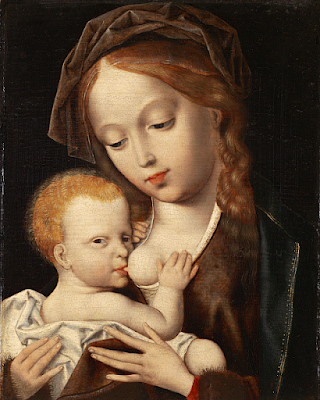
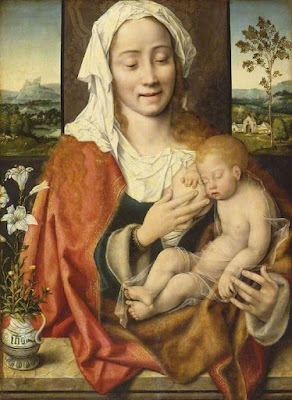
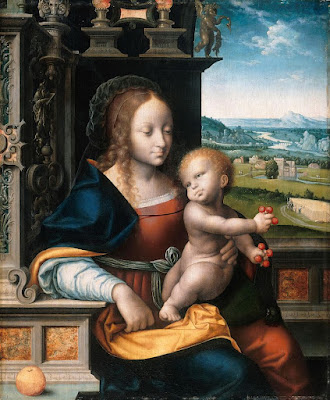
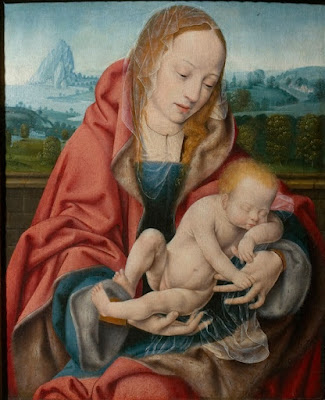
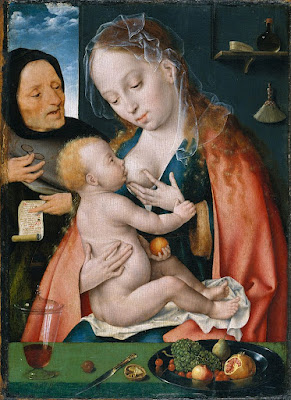
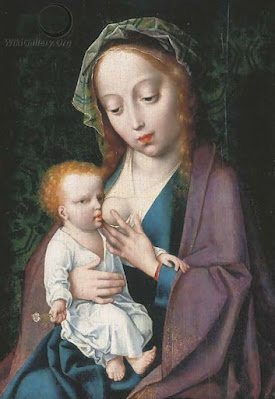
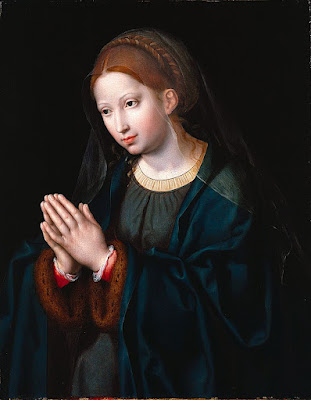
Madonna(s) With Child - Joos van Cleve

This one's a bit of an odd one - numerous depictions of the Virgin Mary with child Jesus. All looking suspiciously ginger. All by the Antwerp-based painter Joos van Cleve.

There are so many I keep getting deja vu thinking I've uploaded them on here before. We've featured many redheaded Madonna and Child paintings over the years, but I think these ones are all new to the blog. Though we have mentioned van Cleve previously, when we featured his equally ginger Altarpiece of the Lamentation.

So here goes..

(Madonna and Child)

(Virgin and Child)

(Madonna of the Cherries)

(Madonna and Sleeping Child
in a Landscape)

(The Holy Family)

(Madonna with Child)

(The Holy Family)

And finally we have an image of Mary alone in prayer. Again red-haired.

(The Virgin in Prayer)

(The Virgin in Prayer - detail)

Definitely images worth adding to the 'Was Jesus Ginger?' folder.